
But enough idle chit-chat; let’s get this show on the road.
Organic Mess
Have you ever wanted to compost, but it just seemed too dang complicated? Then you’re in luck, for Talia has provided some tips on simple composting.
Neighbor Nancy shows y’all how to get some free vegetable seeds and how you can grow a ton in small containers. I’m about to go plant even more plants in old containers now.
TravelCat4 has some handy eco-tips for how to travel in an Earth-friendly manner. My favorite tip was the ‘grow a beard’ one; zero effort required, plus you get that rugged look that draws all the ladies in!
Beth Terry contemplates the pros and cons of recycling plastic into oil. I think it’s great that they’ve found a way to do this, but I do understand Ms. Beth’s concerns.
Ryan and Leslie help us visualize the huge number of plastic bottles used in the U.S. in just five minutes.
Alex has some easy ways to save car fuel, and it looks like he’s from England, talking about “tyres” and “boots”.
Dang, that about wraps it up for this Carnival. Thanks for all the submissions; hopefully I didn’t forget anyone or mess up a link. Until next time, this is EcoJoe, signing off.
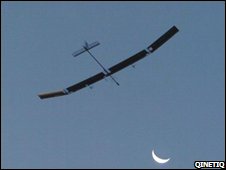
To see the video and read more about the Zephyr-6, head on over to BBC News, and tell them EcoJoes sent you.
A solar-powered plane flew for a little over 82 hours, shattering its old record. The lightweight plane, known as the Zephyr-6, was flown as a demonstration for U.S. military, which is looking for new ways to provide air support for its ground troops.

Dang, 3 days in the air just from solar power. This might be even better than the solar powered bra. Pretty amazing. If they could somehow make solar-powered passenger planes, we could cut down on air pollution while also reducing our dependence on non-renewable fossil fuels. It’s a win-win situation.
I don’t have much to say about this, except that if I was a girl, I would be wearing one all the time.
Triumph International Japan has finally done it; our world’s environmental problems are as good as solved now, for they have done the un-possible — invented a solar powered bra. I haven’t seen a “green” invention this innovative since the new milk jug design came out and confused some people.
The bra is green (in color and philosophy), and has a solar panel attached to it that can be worn around the stomach. It generates enough energy to charge small electronics, like a mobile cellular phone or mp3 player or what have you.
Not only does this bra collect solar power, but it also has plastic pouches that can be filled with water in case you get thirsty. So I guess it might save some water bottles?
But alas, this ingenious invention has some downsides. It can get messed up if it rains on the solar panel, and also, it doesn’t work if it’s covered up with actual clothes. To me, it looks like someone just glued a flexible solar panel to a tanktop. We will be closely monitoring Triumph International’s continuing work on this creation…
This made the front page on Care2, vote for it with all yer might!
When many people think about a “green” house, they picture a small hut made out of mud where people sit on dirt floors, desperately trying to not use any energy. But by doing some careful planning and designing, and paying about 10% more on construction costs, this family’s home uses 50% less water and a whopping 90% less electricity than a similar-sized “normal” home.Some of the things they did are:
capturing rainwater and snow melt to flush toilets or water the lawn
“recycling” heat from hot water to help the water heater
If you’re thinking about building a home in the near future, and you’d like to cut the water bill in half and the electricity bill by 90%, then here’s how. I plan on one day following some of the tips in the video to make my house as cheap (and eco-friendly) as possible, while maintaining that normal home look.
Earthships are houses made with discarded tires, bottles, and cans, put together with lots of dirt. Many of them are self-sufficient, creating their own energy, and capturing their own rain-water. Since they’re made from reused/free materials, and supply their own electricity, heating, and water, they help conserve natural resources while also saving chunks of money. I’m down for anything that helps the environment AND saves me some dinero.
But I digress. I now present to you, courtesy of Earthship.net, “Earthships 101″.
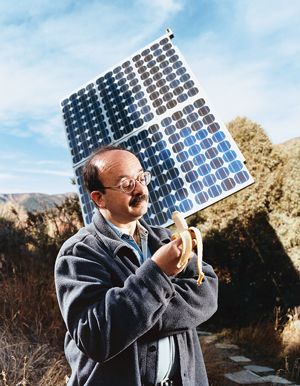
Amory Lovins, who won a MacArthur Genius grant back in 1993 (and an Eco-Hero Award just right now), has been living in a house he built since 1983. It looks like a very nice and comfy house, especially when you consider that, despite living 7,000 feet up in the Rocky Mountains (where it gets pretty dang cold), he pays $0 a year on his heating. Not only that, but his house actually generates more electricity than he needs — so he sells the surplus energy to the power company for some extra cash. Here are three ways to cut your electric bill like crazy.
His secret (one of them) is that he designed his house to be very well insulated. His walls are 16 inches thick, and his large super-insulated windows (made with special glass that insulates as well as 14 normal panes of glass) mean that his house can retain heat quite well.
Passive and Active Solar Heating
Lovins’ house is heated in two main ways: both from sun-rays passing through his many windows, or by means of Amory’s solar panels, which supply his house with more energy than it even uses.
Energy-Efficient Appliances
Much of Lovins’ house is naturally lit by the sun. Besides that, motion-detector lights and energy-efficient bulbs help to cut down on electricity use. His fridge is thickly-insulated, which reduces its energy consumption by quite a lot. His dryer is solar powered, and looks like it uses no electricity at all (watch the video to see how).
Amory Lovins’ home took some extra thought to design and build. It also cost a little bit extra ($6,000). But by cutting his power bill to zero, the extra planning and money spent were easily worth it. If more and more contractors start building this way, you could kiss our “oil prices” and “energy crisis” problems good-bye.
Roads and parking lots. They are everywhere in today’s busy, dog-eat-dog, modern world. They sit there all day, selfishly absorbing the sun’s rays, then squandering all that heat at night by simply releasing it into the night air. Welp, a Dutch company named Ooms Avenhorn Holding BV is now working on ways to take that solar energy and use it to heat homes and offices.
Ooms has already implemented this technology in several places around the Netherlands; solar energy collected from nearby roads and parking lots helps heat an industrial park of 160,000 square feet in Hoorn, a 70-unit apartment building in Avenhorn, and an air force base hangar.
This is a great idea; even on cloudy days, this system of getting heat from roads is effective. Let’s hope that America can build off of this Dutch technology and start using our numerous roads and parking lots to heat our buildings. Just think about how much of our land in cities is taken up by roads and parking lots. Imagine if we were using that captured solar energy to heat our buildings. We could cut our power usage in a huge way, while not sacrificing anything in the way of personal comfort.
A good article about getting energy from asphalt can be found right about here. Thanks to my pop for letting me know about this.