Get Rid of Your Electric Power Bill
March 5, 2008 - Make sure you like EcoJoes on Facebook to stay updated on green ways to save money and help the environment. Just click the "like" button below. Muchas gracias!
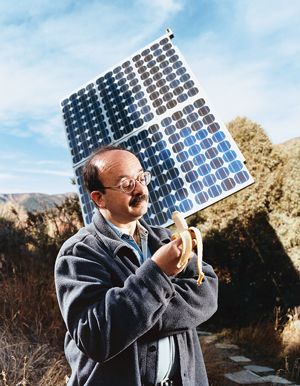 Amory Lovins, who won a MacArthur Genius grant back in 1993 (and an Eco-Hero Award just right now), has been living in a house he built since 1983. It looks like a very nice and comfy house, especially when you consider that, despite living 7,000 feet up in the Rocky Mountains (where it gets pretty dang cold), he pays $0 a year on his heating. Not only that, but his house actually generates more electricity than he needs — so he sells the surplus energy to the power company for some extra cash. Here are three ways to cut your electric bill like crazy.
CLICK HERE TO SEE AN INFORMATIVE YET FUN YET NEAT VIDEO OF HIS HOUSE
Insulate, Insulate, Insulate
His secret (one of them) is that he designed his house to be very well insulated. His walls are 16 inches thick, and his large super-insulated windows (made with special glass that insulates as well as 14 normal panes of glass) mean that his house can retain heat quite well.
Passive and Active Solar Heating
Lovins’ house is heated in two main ways: both from sun-rays passing through his many windows, or by means of Amory’s solar panels, which supply his house with more energy than it even uses.
Energy-Efficient Appliances
Much of Lovins’ house is naturally lit by the sun. Besides that, motion-detector lights and energy-efficient bulbs help to cut down on electricity use. His fridge is thickly-insulated, which reduces its energy consumption by quite a lot. His dryer is solar powered, and looks like it uses no electricity at all (watch the video to see how).
Amory Lovins’ home took some extra thought to design and build. It also cost a little bit extra ($6,000). But by cutting his power bill to zero, the extra planning and money spent were easily worth it. If more and more contractors start building this way, you could kiss our “oil prices” and “energy crisis” problems good-bye.
Thankee to Sam for telling me about this homey
Sounds very interesting and I agree with you on house insulating and energy efficient appliances.
The sole point on which I disagree is about building houses like this would solve the problem. Of course, this would help, but not that much.
To the research I done on France, insulating the 31 million existing houses is a priority as they consume way too much.
I think it must be the same for you in the US. 😛
spread the word, spread the word! Thanks, ecojoe–I've sent your site to 20 people, who ought to get on it–and each get 20 more. Gotta save our poor old mother earth….
Thanks!!!! If everyone kept spreading it to 20 new people, EcoJoes could eventually be seen by every single person on Earth! Dang, imagine what kind of world THAT'D be.