Normal wind turbines are okay, I guess, but what about a horizontally spinning one that generates a lot more power, up to twice as much power as some other wind turbines?
Check out this 885-foot wide wind turbine named the Aerogenerator X Vertical Axis Wind Turbine. It’s being built ahora, and will be finished by 2014. Once it’s done, it’ll generate over 10 megawatts per hour, beating out the current wind turbine record of a little over seven megawatts.
If you want more information about these crazy horizontal wind turbines of the future (and hey, who wouldn’t?), click on THIS HERE LINK.
Second, I just yesterday got back from mi luna de miel. What with that and helping with wedding planning, my life was purty dang busy.
Anyhoo, enough about me. What I bring to you today is a good video from TED Talks showing time lapse proof of extreme ice loss.
James Balog, a photographer, founded the Extreme Ice Survey to capture the changing glaciers by time-lapse photography and video. His goal is to show everyone visual proof of just how fast glaciers are melting.
Dang!! Back in college, me and some of my friends talked a lot about creating perpetual motion machines, and came up with all kinds of different designs. Eventually we decided it was impossible, and abandoned the idea.
But apparently some people did not give up, and recently the famous Alex Chiu announced that he had built a working perpetual motion machine. The only caveat is that it will not work on Earth — it needs the zero-gravity of outer space.
Still, this should revolutionize everything. Not since his immortality device has such an invention been unveiled to the world. Free, limitless energy should dramatically lower pollution and energy costs, and get rid of the need for gasoline and coal.
To see the video and read more about the Zephyr-6, head on over to BBC News, and tell them EcoJoes sent you.
A solar-powered plane flew for a little over 82 hours, shattering its old record. The lightweight plane, known as the Zephyr-6, was flown as a demonstration for U.S. military, which is looking for new ways to provide air support for its ground troops.
Dang, 3 days in the air just from solar power. This might be even better than the solar powered bra. Pretty amazing. If they could somehow make solar-powered passenger planes, we could cut down on air pollution while also reducing our dependence on non-renewable fossil fuels. It’s a win-win situation.
That’s right, folks, it’s movie time. So sit back, relax, and get ready for some surious learning as Amory Lovins narrates this neato video about Hypercars. All you have to do is ; look, here he is now:
Fun Facts about Hypercars
Very light weight, very strong (carbon fiber, the same as Formula One race cars)
Less wind resistance
More efficient electric accessories (A/C, CD player, etc.)
Increase fuel efficiency dramatically
Windows let in light, but not heat (reducing need for A/C)
Amory says it’s possible we’ll see hypercars on the market within 4 to 5 years. Hopefully my car can hold out that long, then I’ll spring for a crazy efficient hypercar and watch my gas savings pile up.
Last night, me and Tiff were heading home after getting swole at the gym, when much to my surprise a Smart Car drove by. I managed to get an amazing, high-quality photograph of it as it sped by.
That’s actually how it looked; it is so eco-friendly that it was warping space-time (that’s why the lights look weird, they are being bent). Stephen Hawkings explains this phenomenon in detail in A Briefer History of Time, available at your local public library.
BBC has an interesting article today about people’s impact on the world’s oceans. Give it a looksie.
One thing I wish they’d done differently is to say exactly what criteria they used for their ratings. Anyhoo, scientists figure this map will be useful for determining what areas of the ocean most desperately need help. These scientists are now in consideration for the prestigious Eco Hero award.
 Dang!! Back in college, me and some of my friends talked a lot about creating perpetual motion machines, and came up with all kinds of different designs. Eventually we decided it was impossible, and abandoned the idea.
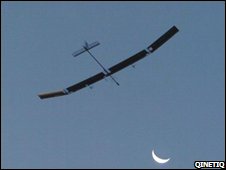 A solar-powered plane flew for a little over 82 hours, shattering its old record. The lightweight plane, known as the Zephyr-6, was flown as a demonstration for U.S. military, which is looking for new ways to provide air support for its ground troops.